Why Occupational Health Compliance Is Becoming a Business Priority
Occupational health is no longer only a medical or workplace-safety responsibility. For modern enterprises, it is increasingly connected to compliance, operational continuity, workforce risk, and management accountability.
As organizations expand across locations, workforce health information becomes increasingly difficult to manage through disconnected records, spreadsheets, documents, and manual processes. The challenge is not simply maintaining employee health records. It is maintaining them in a way that supports accountability, compliance, timely decisions, and audit readiness.
Occupational health sits at the intersection of healthcare, workplace safety, employee wellbeing, and organizational compliance. That makes the quality of the systems used to manage it an important consideration for HR leaders, medical teams, compliance officers, and management.
Occupational Health Is More Than Record Keeping
A traditional approach to occupational health may focus primarily on examinations, medical certificates, fitness assessments, and maintaining employee records. While these remain essential, enterprise organizations increasingly need visibility across the entire occupational health lifecycle.
An employee assessment can lead to a medical report. A report may influence a fitness decision. A workplace incident may require follow-up. An expiring certificate may require another examination. Each activity creates information that can become important later.
When these activities are managed independently, important relationships between records and actions can become difficult to trace.
Compliance is not achieved by collecting more documents. It depends on whether critical health information can be managed, accessed, reviewed, and traced responsibly.
Why Compliance Has Become a Management Concern
Occupational health compliance increasingly affects multiple levels of an organization. Medical teams may manage examinations and assessments, HR teams may need workforce visibility, compliance teams may require documentation, and management may need information about emerging risks and outstanding actions.
This makes occupational health data more than a collection of individual medical records. It becomes part of the organization's broader operational and compliance infrastructure.
Workforce Visibility
Organizations need a clearer view of workforce health activity across sites, departments, and employee groups rather than relying on isolated records.
Documentation Control
Medical reports, certificates, assessments, and supporting documents need to remain organized and accessible to authorized teams.
Traceability
Critical assessments, incidents, actions, and follow-ups should leave a clear and accountable record.
Audit Preparedness
Teams should be able to locate relevant information efficiently when internal or external reviews require it.
The Risk of Fragmented Occupational Health Processes
Fragmented systems create more than administrative inconvenience. They can make it difficult to establish which information is current, who has reviewed it, what action was taken, and whether a required follow-up has been completed.
Common examples include health records maintained in spreadsheets, certificates stored across different folders, appointment information managed separately, or incident reports that are not connected to the employee's broader occupational health history.
As the workforce grows, these gaps become increasingly difficult to manage manually.
The operational consequences can include:
- Limited visibility across locations and workforce groups.
- Higher administrative effort for medical and HR teams.
- Difficulty tracing information during reviews or audits.
- Delayed follow-up on assessments, incidents, or required actions.
- Greater dependency on individuals who understand where information is stored.
What a Modern Occupational Health System Should Provide
A modern occupational health environment should make critical information easier to manage without compromising control over sensitive workforce health data.
The objective is not simply to digitize existing paperwork. It is to create structured workflows that connect the activities taking place across occupational health operations.
Centralized workforce information
Employee health histories, assessments, medical reports, certificates, and related documentation should be organized within a controlled environment.
Structured clinical workflows
Appointments, examinations, assessments, reporting, and follow-up activities should follow consistent workflows that reduce unnecessary administrative effort.
Management visibility
HR, medical, compliance, and management teams should be able to access relevant information according to their responsibilities and make decisions based on current, structured data.
Traceable activity
Important actions and records should remain identifiable throughout the occupational health process, supporting accountability and organizational review.
Compliance Should Be Built Into the Process
The strongest compliance approach is not to prepare for an audit only when one is announced. It is to structure everyday occupational health operations so that records, workflows, and decisions remain organized throughout the year.
This changes the role of compliance from a periodic administrative exercise into an ongoing operational discipline.
When occupational health processes are structured correctly from the beginning, audit readiness becomes an outcome of good operational governance rather than a last-minute exercise.
Building a More Accountable Occupational Health Function
For organizations managing occupational health across multiple teams or locations, the next step is to move beyond disconnected tools and manual processes toward a more structured digital operating model.
This does not mean replacing clinical judgment or the expertise of occupational health professionals. Instead, technology should support those professionals by making the information they need easier to manage, trace, and review.
The result is an occupational health function that is better positioned to support workforce health while also meeting the organization's broader expectations for governance and compliance.
The Role of Sodium OHC
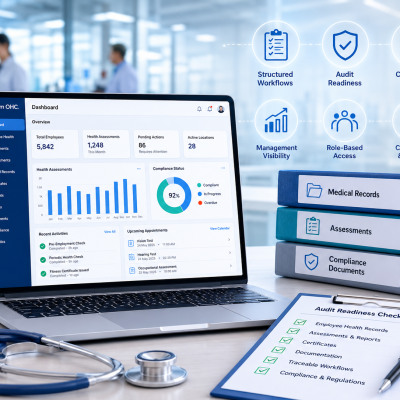
Sodium OHC is designed around this operational approach. It brings employee health records, appointments and assessments, medical documentation, incident reporting, dashboards, and document management into a structured occupational health environment.
For organizations managing sensitive workforce health information, the objective is straightforward: create better visibility, stronger operational control, and a more consistent foundation for occupational health management.
Build a More Audit-Ready OHC Function
Discover how Sodium OHC can help your organization structure workforce health records, clinical workflows, documentation, incidents, and compliance oversight within one controlled platform.
Book a Demo