How Occupational Health Compliance Helps Organizations Stay Audit-Ready
Occupational health compliance is more than maintaining documents for an occasional audit. It requires organizations to establish structured processes for managing employee health information, medical records, workplace incidents, assessments, and compliance-related activities.
What Does Occupational Health Compliance Really Mean?
Occupational health compliance refers to the systems, processes, and controls organizations use to manage workforce health responsibilities in accordance with applicable laws, regulations, standards, and internal requirements.
For enterprises, this can involve employee medical records, fitness assessments, periodic examinations, medical certificates, incident documentation, workplace health programs, and records required for internal or external review.
The challenge is not simply collecting this information. Organizations must also be able to demonstrate that records are organized, processes are followed, responsibilities are clear, and important activities can be traced when required.
Organizations that build structured occupational health processes into everyday operations are better positioned to retrieve information, demonstrate accountability, identify gaps, and respond efficiently when documentation is requested.
Four Foundations of an Audit-Ready Occupational Health System
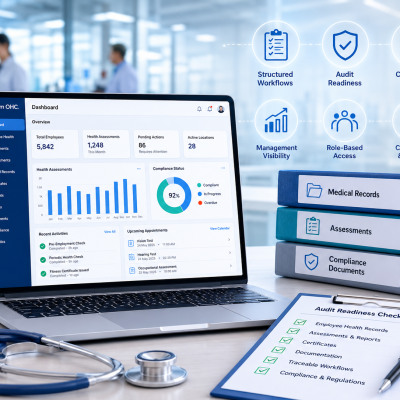
Centralized Records
Employee health records, assessments, medical reports, certificates, and supporting documentation should be maintained within a structured system rather than scattered across disconnected sources.
Traceable Workflows
Critical activities should have a clear record of what was performed, when it occurred, and which authorized team or professional was responsible for the activity.
Controlled Access
Sensitive occupational health information requires appropriate access controls so that users can work with the information relevant to their responsibilities.
Management Visibility
Leadership teams need visibility into important trends, pending actions, incidents, assessments, and compliance-related activities without compromising the confidentiality of individual records.
Why Manual Compliance Processes Create Risk
Many organizations still depend on spreadsheets, paper documents, emails, shared folders, and disconnected applications to manage occupational health information. While these methods may work for small volumes of information, they can become difficult to manage as the workforce and number of locations grow.
Manual processes can make it harder to determine whether records are complete, whether assessments are pending, where a particular document is stored, or whether an incident has received the required follow-up.
These gaps can create unnecessary administrative work and make compliance oversight more difficult.
What an Audit-Ready Occupational Health System Should Help You Track
- Employee health records and medical histories
- Occupational health examinations and assessments
- Fitness certificates and medical documentation
- Workplace health incidents and follow-up actions
- Pending assessments, reviews, and required actions
- Documentation across departments and organizational locations
- Access to sensitive information based on user responsibilities
- Operational information required for compliance oversight
From Compliance Records to Everyday Operational Control
Audit readiness should not be treated as a separate activity that begins when an audit is announced. It should be a natural outcome of how occupational health information is managed every day.
Capture
Record employee health information, assessments, incidents, reports, and relevant documentation in a structured environment.
Organize
Keep information connected to the appropriate employee, workflow, department, location, or occupational health activity.
Monitor
Give authorized teams visibility into pending actions, assessments, incidents, documentation, and operational trends.
Demonstrate
When information is required for review, teams can work from structured records rather than searching through disconnected systems and manual files.
Building Compliance Into Occupational Health Operations
A strong occupational health compliance strategy combines people, processes, governance, and technology. Software cannot replace organizational responsibility, clinical judgment, or regulatory expertise, but it can provide the structure required to manage information and workflows consistently.
For organizations operating across multiple locations or managing large workforces, a centralized occupational health platform can provide greater visibility while reducing dependence on fragmented administrative processes.
The goal is simple: make compliance part of everyday occupational health operations instead of treating it as an exercise performed only when an audit approaches.
Build a More Audit-Ready Occupational Health Operation
Sodium OHC brings workforce health records, medical workflows, incident reporting, documentation, and compliance oversight into one structured enterprise platform.